


Breaking Enigma: Alan Turing Opens Up the Future of Computing
BREAKING ENIGMA
Cryptography - Part 1: ALAN TURING OPENS UP THE FUTURE OF COMPUTING (AUTOMATIC COMPUTER)
CRYPTOGRAPHY
Throughout human history there have been wars for power. The great generals who built mighty empires such as: Alexander the Great, Caesar, Genghis Khan, Saladin … all gained the upper hand to win based on these factors:
- Better Logistics technology than the opponent
- Better Information technology than the opponent
- Better Weapons technology than the opponent
Cryptography is an important part of information technology; Gaius Iulius Caesar, from 100 to 44 BC, is known as a military dictator, but Caesar is also known as the father of cryptography. In cryptography, the Caesar cipher, also called the shift cipher, is one of the simplest and best-known ciphers. Caesar used his cipher for correspondence and military orders. If a letter fell into enemy hands — for example, if the messenger was captured — the information would not be revealed: without the decryption key, it cannot be read.
In its era, the Caesar cipher was the most advanced information technology.
ENIGMA
In World War II, Nazi Germany also possessed the world's most advanced cryptographic technology - Enigma
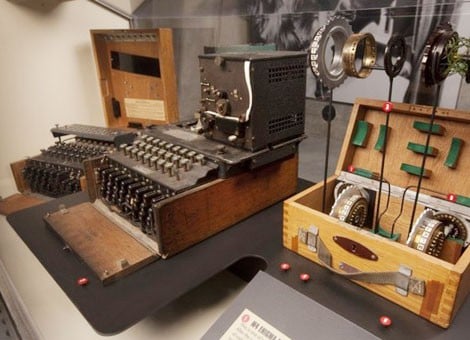
Enigma machine
Enigma was born in 1918 as a commercial product; in 1926 the German Navy bought it, and 3 years later Nazi Germany used it widely for military purposes. This machine encrypted all correspondence, keeping German military information completely secret.
A machine that looked like a typewriter placed in a wooden box, with a system of letter wheels and a plugboard to permute letters. Despite its seemingly simple appearance, Enigma hid a great encryption power. Enigma was not the world's first encryption machine, but it was the most complete. It could produce 159 million million million different possibilities.
If 10 people sat testing every Enigma encryption setting, working 24/7, it would take 20 million years to decrypt a single message. In World War II, the Allies had at most 18 hours to decrypt, because after midnight the Enigma machines were instructed to change their configuration, creating 159 million million million entirely different possibilities.
The Enigma machine is a combination of mechanical and electrical — electromechanical — systems. The mechanical systems include a keyboard; a set of geared discs called rotors with a rotating shaft to encipher letters; and a lampboard of flashing bulbs showing the enciphered letters.
The rotors form the heart of an Enigma machine. Each rotor is a disc about 10 cm in diameter made of hard rubber or bakelite with brass, springs, and electrical contact pins arranged in a circle. Each contact pin represents a letter of the alphabet, usually the 26 letters from A-Z. The rotors are mounted on a main shaft with the pins contacting the adjacent rotor.
In operation, cipher clerks fitted the rotors into the machine and set them in a pre-arranged order by rotating them, then prepared a plugboard to swap 6 pairs of letters. When Enigma was ready, the clerks began typing the message into the machine. For each character, the corresponding bulb above would light up. The operator recorded all the enciphered characters — meaningless at this point — then sent them by Morse code. At the receiving end, the cipher clerk also set the rotors of their Enigma exactly according to the message key.
The translation process was reversed, letter by letter, and the bulbs lit up corresponding to the decrypted letters. In use, Enigma required a list of daily settings and supporting documents. The German Navy's codebooks were printed in red, with water-soluble ink on pink paper so they could be easily destroyed if capture threatened. With about 10 million billion different encryption settings, the Germans always believed no one could break their cipher.
BREAKING ENIGMA - ALAN TURING
In WWII, Alan Turing was a key contributor at Hut 8, Bletchley Park, in breaking German ciphers. He contributed deep insights into decrypting both the Enigma and Lorenz machines, and he served as head of Hut 8, the section responsible for intercepting and reading German Navy signals.
The bombe of Turing and Welchman
Within just a few weeks of arriving at Bletchley Park, Turing invented an electromechanical machine to decrypt the Enigma, named the bombe. The bombe became the primary tool for reading the traffic sent back and forth from Enigma machines.
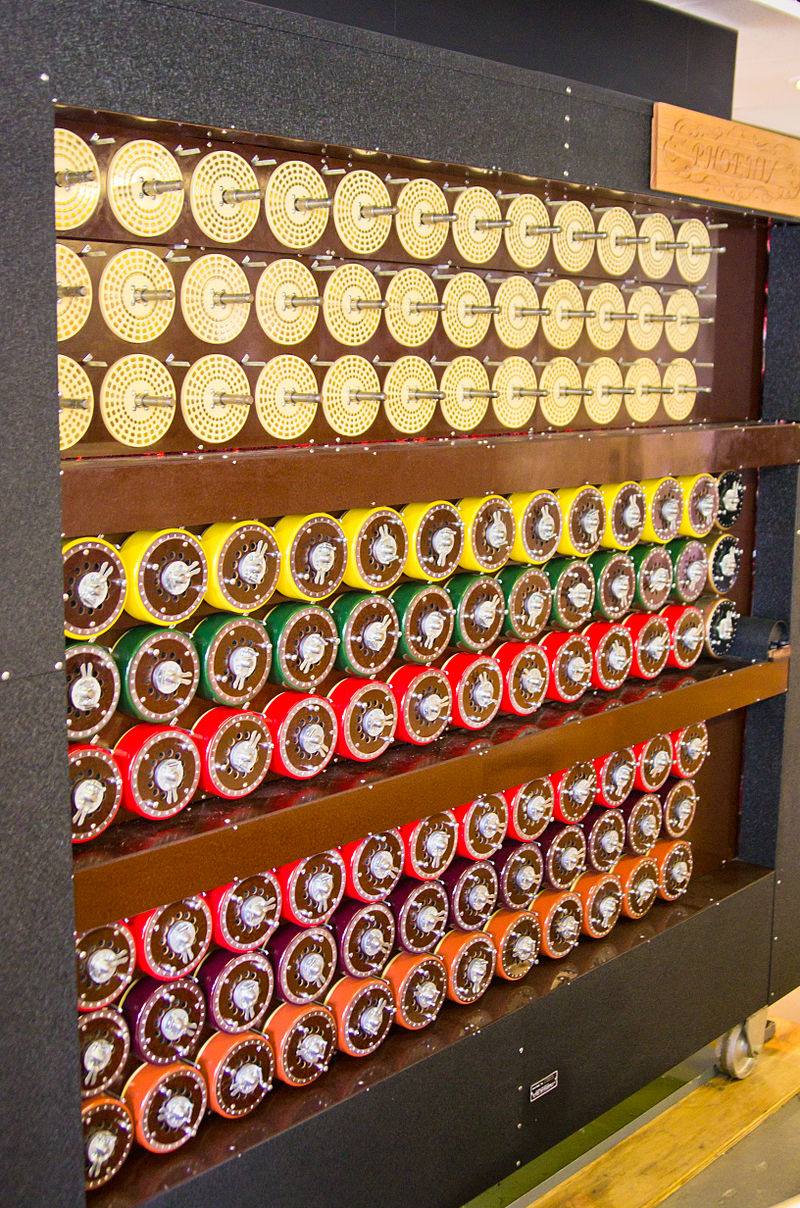
Bombe machine
The bombe searched for the rotor settings of the Enigma machine using a brute-force algorithm, and it needed a crib — a piece of unencrypted text and the corresponding ciphertext. For each candidate rotor setting, the bombe ran a chain of logical deductions based on the crib, using assembled electronic circuits. The bombe searched for and detected contradictions as they occurred, eliminated the setting that caused the contradiction, and continued searching for another, more plausible setting. Most candidate settings caused contradictions and were eliminated, leaving only a few possible settings for more detailed study.
Turing's bombe was first assembled on March 18, 1940. Thanks to it, every day the British successfully decrypted about 3,000 secret German military messages within minutes of loading the intercepted data. From then on, all messages could be read in real time. As many as 210 British bombes were built during the war, and all were destroyed in the final days of the conflict.
Automatic Computing Engine
Opening up the future of computing
From 1945 to 1947, Alan Turing worked at the UK National Physical Laboratory. There he designed the ACE (Automatic Computing Engine). On February 19, 1946, he submitted Britain's first complete design for a stored-program computer, the beginning of electronic computing machines — computing — which each of us, the moment we hold a smartphone in our hands to read and enjoy these lines, is enjoying the fruit of the pioneer Alan Turing.
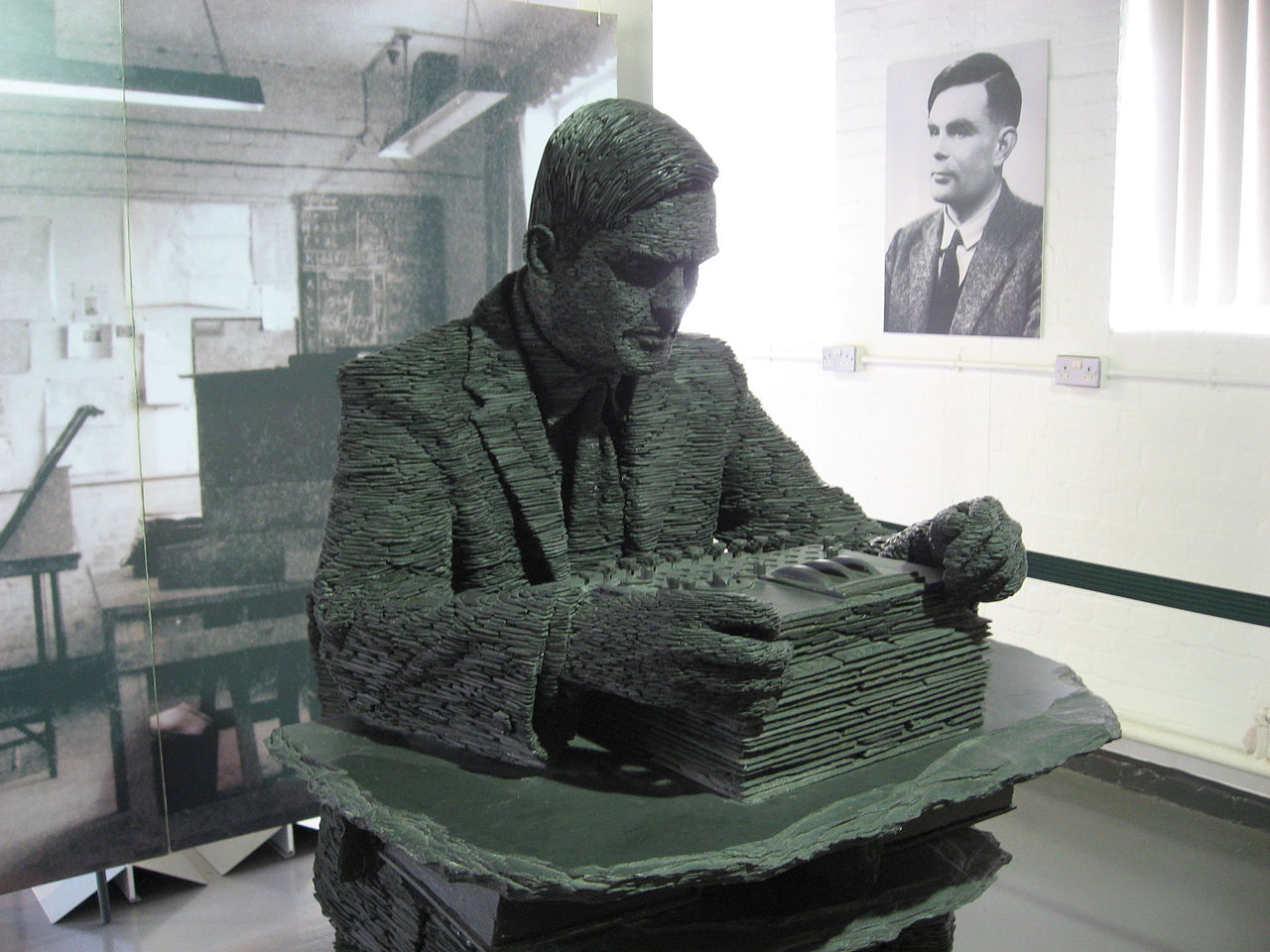
The Alan Turing Memorial
ARTIFICIAL INTELLIGENCE
A.I & Turing Test
While resting at Cambridge, Alan Turing continued abstract work, and in the paper "Computing Machinery and Intelligence" — Mind journal, 1950 — he discussed the problem of "artificial intelligence" and proposed a test method now called the Turing test, a standard definition of a machine being "sentient" that A.I. developers aspire to pass
Recently, KFK 2060, a chatbot claiming to be a person from the future, has been making waves on the Chinese social network Douban but still has not passed the Turing Test defined 70 years ago, because with just a little attention one can tell KFK is a chatbot.
source: dev@onyx.vn