


The Gap Between A.I. and Humans
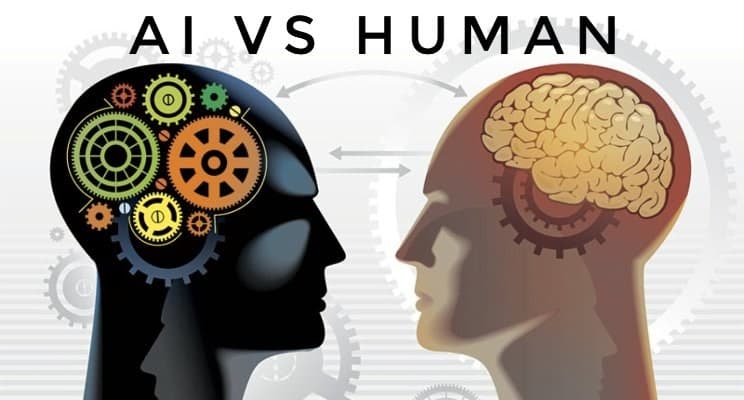
THE GAP BETWEEN A.I. AND HUMANS
DeepMind's achievements in recent years are truly great strides in artificial intelligence; even so, the ability to play board games is not yet cognitive capability. Demis Hassabis of DeepMind's ambition of a General AI — an AI capable of transforming information into knowledge — is surely a grand story.
But so far, the cognitive capability of the strongest AI cannot yet compare with a 2-year-old, even a 1-year-old child. Every free Mind possesses self-awareness: from experience come notions, and notions named by language form knowledge. The characteristic ways knowledge is used shape ethics and personality — these are the traits of a free Mind.
For example, how can a robot display a sense of humor like the robot TARS in the movie Interstellar by the Christopher Nolan brothers?
If you were an AI programmer, how on earth would you manage?
Humor itself is a personality trait formed on a knowledge foundation. Humor is using and connecting different concepts, on different aspects, in unusual ways, to unexpectedly refer to a related concept; in a positive direction, this can be funny.
So in general, when an AI can configure its level of humor — even if config-and-run, configured once at startup and used forever — that would still be an interesting science fiction story, because the AI would have to truly perceive many semantic aspects of a concept; it would be a real mind, not just a chatbot operating on a finite set of nominal word structures.
So what really is that gap? How can the gap be filled?
The gap may be the internal structure of each neuron — natural vs simulated; the gap may also be information living in natural structures instead of just the static states of machines; the gap may also be natural language that names and describes all concepts, from the concrete to the abstract; the gap may also be the mechanisms of emotion and intuition, elements never yet simulated.
We believe Cognitive Science — a new and rapidly growing discipline — will soon answer those questions.
Before those questions are answered, we think there is no need to get worked up about the threat of the Sophia chatbot destroying humankind; Sophia — the citizen of Saudi Arabia — only talks big according to a script, nothing to fear.
At STECH we are not afraid of AI destroying humanity; instead, we focus on researching useful applications of AI, such as recognition problems and problems of finding features of things and phenomena. These are all hard problems consuming many resources; useful applications cannot be had by simply deploying open-source codebases without a scientific grounding in this discipline.
- source: dev@stech.vn -